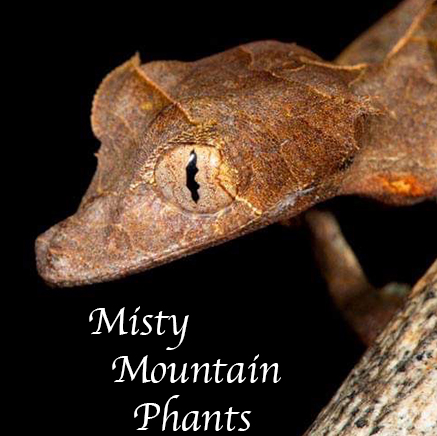
Introduction to the Satanic Leaf-tailed Gecko

It’s nighttime in the rainforests of Madagascar. The air is cool and thick with humidity. Every surface glistens with moisture. And there, perfectly still on a branch at eye level, a pair of eyes watches back—unmoving, otherworldly.
Transcript:
THE BRANCH DEMON PODCAST
EPISODE 1: “INTO THE NIGHT FOREST”
It is night. It has been raining. It is cool and the fog has moved in. I’m moving slowly through mountain trails in Maromizaha, Madagascar. Every leaf..every surface…is coated in moisture. Moss covered branches seem to radiate with life in the light of my headlamp.
And there… perfectly still on a branch at eye level…a pair of eye looking back at me. Unmoving….is a Uroplatus phantasticus.
The satanic leaf-tailed gecko.
A phant.
This is the Branch Demon Podcast, and I’m Bill Strand.
Welcome to the Night Forest.
I’ve been walking this forest trail for about many hours now. In Maromizaha we spent the afternoon climbing up to the summit. This gavels the opportunity to find wildlife during the day. This is when we hope to find phants sleeping. I want you to understand something about finding these animals: it’s not easy. They’re masters of camouflage. They’re completely still – they are sleeping, of course. And they look like…well, dead leaves. And there are dead leaves all over! Not just on the ground, where we actually wouldn’t expect to find a phant, but trapped in the branches where we absolutely would expect to find a phant! So there are a lot of dead leaves to study carefully before you find one of those leaves to be a gecko.
We stay at the summit until nightfall. It is beautiful and, as the evening approaches we can see the clouds depends and fill up the valley. We will be hiking down the mountain through a cloud.
On the way down we experience the forest at night. Far from quiet sleeping, the night shift is just as active as the day. Insects are buzzing around and moths flitter through the night. And, now, we are looking for phants awake.
There’s this moment—and no matter how many times I have experienced it, it never gets old—where your eyes finally lock onto something that doesn’t quite belong. A shape that’s almost right, but not quite. A texture that’s *too* perfect. A leaf that’s somehow… watching you.
That’s nothing short of magic.
This is what we’re going to talk about in this series. This creature. This moment. And what it takes to bring a piece of this—
—into your home.
But to understand the animal, you need to understand where it lives. Because you can’t really know a phant without knowing the Night Forest.
The humidity here is incredible. It’s not the sticky, oppressive humidity of a summer day back home. It’s cool humidity. Clean. You can feel moisture on your skin, in your lungs. Every surface—every leaf, every branch, every inch of bark—is covered in a thin film of water.
The branches here create this three-dimensional maze. Horizontal perches crossing at different heights. Diagonal highways connecting the canopy. Vertical trunks creating support structure. And everywhere—*everywhere*—there are hiding spots. Places to disappear. Places to watch from. Places to feel safe.
This is the template we’re going to work from when we build a cage. Not just “18 by 18 by 24 inches.” This. This structure. This feeling of depth and complexity and choice.
I remember the first time I saw a phant. Actually saw one in person, not just in photos. It was at a reptile importer, decades ago. And my immediate reaction was: “That can’t be real.”
Because they look fake. They look like something an artist created. Like someone took the concept of “leaf-tailed gecko” and pushed it to its absolute extreme. The tail that looks exactly like a dead leaf. The serrated edges. Those enormous eyes. The little demon horns. The way they hang themselves on a branch and just… vanish in plain sight.
And then I learned more about them. They’re from Madagascar, which makes sense because Madagascar is where evolution gets weird and wonderful. They’re nocturnal, which explains those eyes. They’re arboreal specialists, which explains that tail.
They’re also a challenge. They’re a puzzle. They’re an invitation to create a home environment that is truly unique.
And if you’re the kind of person who hears that and thinks “yes, that sounds amazing”…
…then you’re in the right place.
Okay. Let’s talk about what a phant actually is.
Uroplatus phantasticus. That’s the scientific name. Uroplatus is the genus—the leaf-tailed geckos. There are about 18 species in this genus, all endemic to Madagascar. All specialists in camouflage in different ways. All fascinating.
Phantasticus is one of the smaller species. Very specialized. And arguably—though I might be biased—the most incredible.
They live in specific regions of Madagascar’s rainforests. Eastern rainforests, mostly. Mid to high elevation. Areas where it stays cool and humid year-round. Where there’s complex branching structure and plenty of hiding spots.
They’re nocturnal. Meaning they bounce around at night. During the day, they find a secure spot—usually hiding in a branch thicket or hidden behind a leaf—and they do not move. They rely entirely on camouflage for protection during daylight hours. They might even be in plain sight, draping themselves over a branch in an unnatural form which literally, does not look lime an animal.
At night, they come alive. They hunt. They explore. They navigate their territory. They exist on their own timeline, doing exactly what millions of years of evolution designed them to do.
And here’s something critical to understand right from the start: they’re not social animals. In the wild, you don’t see groups of phants hanging out together. You see individuals, well-spaced, each living their own lives.
We’re going to come back to that in a future episode, because it’s important. Really important. But for now, just know: these are solitary specialists.
So why “satanic leaf-tailed gecko”? Where does that name come from?
Well, “leaf-tailed” is obvious. Look at that tail. It’s literally a leaf. Serrated edges, flat shape, they even curl it sometimes to make it look even more like dead vegetation.
But “satanic”?
There are a few stories. One is that when they feel threatened, they open their mouths wide showing this bright red interior and it looks… demonic. Especially if you weren’t expecting it.
Then there are those huge eyes with horns above them, the cryptic coloration, the way they seem to appear out of nowhere. There’s something otherworldly about them.
Personally, I think “satanic” is overdramatic. They’re not aggressive. They’re not mean. They’re actually quite gentle if you handle them carefully—though we’re going to talk about why you mostly shouldn’t.
But the name stuck. And honestly? It’s memorable. It’s conversation-starting. And it captures something about the mystique of these animals.
Though if you spend any time in the phant community, you’ll mostly hear people call them just “phants.” P-H-A-N-T. It’s easier to say. It’s affectionate. It feels like you’re in on something.
So why phants? Why these specific animals?
There are a lot of geckos in the world. There are a lot of amazing reptiles. There are easier animals to keep, flashier animals, more interactive animals.
Why do people become obsessed with phants?
I think it’s because they’re the perfect intersection of beauty, challenge, and mystery.
They’re beautiful in this weird, alien way. Not cute. Not traditionally pretty. But *fascinating* to look at. Every detail is perfect. The camouflage. The tail. Those eyes. The way they move—slowly, deliberately, like they’re calculating every step. Then that coiling up and leap into space.
They’re challenging in the right way. Not impossible. Not necessarily beginner-friendly, but not so difficult that only experts can succeed. They require you to think. To problem-solve. To create something really well-designed.
And they’re mysterious. You can keep a phant for years and still wonder what they’re thinking. Still feel like you’re observing something wild and unpredictable even though it’s in an enclosure in your home.
And they make you work for it.
They’re not going to run up to the front of the cage to greet you. They’re not going to beg for attention. They’re not going to perform.
They’re going to be exactly what they are: a small, perfect piece of Madagascar’s night forest, living their life whether you’re watching or not.
And when you accept that—when you stop expecting them to be a traditional “pet” and start appreciating them for what they are—that’s when the magic happens.
That phant we talked about at the beginning of this episode? The one on the branch at eye level?
It stayed perfectly still while I took my photographs – except for those eyes tracking me.
After I got my shots I let him go back to his life and went to observe a sleeping chameleon. A little while late, just out of curiosity, I came back tot he spot where the phant was. And, he was gone…slipped into the night
That’s what we’re talking about in this series. Creatures that move through the world on their own terms. Invisible until they choose not to be.
And the question we’re going to explore together over the upcoming episodes is this: What does it take to create a piece of Madagascar in your own home? Not just a cage with a gecko in it. But a real, functioning slice of this night forest. A place where one of these incredible animals can live the way it’s meant to live.
It’s not as hard as you might think. But it’s also not simple. It requires knowledge. It requires careful planning. It requires understanding these animals and respecting what they need. Luckily, we have that information available and that will give us a rich group of topics to build this show around.
And that’s what we’re going to do together.
I’m Bill Strand, and this is the Branch Demon Podcast.
Next time, we’re going to get much closer to these incredible creatures. We’re going to talk about their behavior, their personality, what makes each individual unique.
Until then…welcome to the Night Forest.